Early Childhood Environment Rating Scale®, Third Edition (ECERS-3™)


The long-anticipated new version of the internationally recognized Early Childhood Environment Rating Scale®, ECERS-3™ focuses on the full range of needs of preschool- and kindergarten-aged children. This widely used, comprehensive assessment tool measures both environmental provisions and teacher-child interactions that affect the broad developmental needs of young children, including cognitive, social-emotional, physical, and health and safety. ECERS-3™ also includes Items assessing developmentally appropriate literacy and math activities. Spiral bound. 104 pages.
Designed for preschool, kindergarten, and child care classrooms serving children 3 through 5 years of age, ECERS-3™:
- Provides a smooth transition for those already using ECERS-R™
- Emphasizes the role of the teacher in creating an environment conducive to developmental gains
- Is designed to predict child outcomes more accurately and with greater precision
- Provides a stronger method of distinguishing between good and truly excellent programs
- Offers a complete training program with ongoing support available at the Environment Rating Scales Institute (ERSI) website (www.ersi.info)
- Space and Furnishings
- Personal Care Routines
- Language and Literacy
- Learning Activities
- Interaction
- Program Structure
ERS™ and Environment Rating Scale® are registered trademarks of Teachers College, Columbia University
Debby Cryer
 Debby Cryer, Ph.D., is a Scientist at the Frank Porter Graham Child Development Institute, University of North Carolina at Chapel Hill. She has taught in a variety of early childhood programs, recently directed the child care program at the FPG Center, and has studied and written about early childhood program quality for more than twenty years. Throughout her career, she has combined her interests as an early childhood practitioner with those of a researcher, studying real-world issues and translating research findings into practice for early childhood program staff, parents, and policy makers.
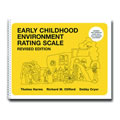
Dr. Cryer is co-author of the Infant/Toddler Environment Rating Scale®, (Harms, Cryer & Clifford, 1990) and the Early Childhood Environment Rating Scale®, Revised Edition (Harms, Clifford & Cryer, 1998) and has worked with various teams to develop numerous other quality assessment instruments. She has developed a variety of resources for teachers and for others interested in early child care and education, such as the popular Active Learning Series (Cryer, Harms & Bourland, 1986, 1987; Cryer, Harms, Ray, 1996), and the award-winning public television series, "Raising America's Children" (Harms & Cryer, 1988). Her most recent books include Infants and Toddlers in Out-of-Home Care (edited by Cryer & Harms, 2000), and the Early Childhood Education and Care in the USA (edited by Cryer & Clifford, 2003), both published by Paul H. Brookes.
Dr. Cryer was a Principal Investigator for the national study on Cost, Quality and Child Outcomes in Child Care Centers, and continues that research in the International Child Care and Education Study. She is currently Principal Investigator of two studies investigating the effects of continuity of caregivers on infants and toddlers in child care.
Thelma Harms
 Thelma Harms, Ph.D., is Director of Curriculum Development at the Frank Porter Graham Child Development Institute and Research Professor in the School of Education at the University of North Carolina at Chapel Hill, where she has been since 1975. She earned an M. A. in Child Development and a Ph. D. in Early Childhood Education at the University of California at Berkeley, where she served as a head teacher in the Harold E. Jones Child Study Center laboratory school for 15 years. Dr. Harms has lectured and conducted training throughout the U.S. as well as in Canada, Germany, Portugal, Sweden, Hong Kong, Singapore, South Korea, and Russia. Her areas of specialization are program evaluation, curriculum, and staff development.
Dr. Harms is the lead author of four widely used program evaluation instruments: the ECERS-R™ (Harms, Clifford, & Cryer, 1998); the FDCRS (Harms & Clifford, 1989); the ITERS-R™ (Harms, Cryer & Clifford, 2003); and the SACERS™ (Harms, Jacobs, & White, 1996). She consulted with the National Association for the Education of Young Children (NAEYC) in the development of its center accreditation instruments and validator training procedures and is a co-author of the school age child care assessment instrument, which is being used in the NSACA accreditation. Dr. Harms co-chaired the national committee that developed quality criteria for family child care programs and developed an accreditation process and instruments for military family child care.
Dr. Harms has co-authored a number of curriculum materials including: the Family Day Care Education Series; the seven volume Active Learning Series; the Cook and Learn Series, Nutrition Education for Preschoolers; and the 10-part educational television series, "Raising America's Children". She has co-edited a book on working with homeless preschool children in shelters and a recent volume on infants and toddlers in out of home care.
In addition to training courses offered through the Frank Porter Graham Child Development Institute in Chapel Hill, Dr. Harms provides training and consultation in collaboration with agencies in many other states and countries.
Richard M. Clifford
Richard M. Clifford, Senior Scientist Emeritus, Frank Porter Graham Child Development Institute, University of North Carolina at Chapel Hill. Dr. Clifford has written and consulted extensively on child and family policy issues with special emphasis on the role of government in the provision of early childhood services. In addition, he has done research on early learning environments and their impact on young children. He was Principal Investigator on the National Center for Early Development and Learning study of state funded pre-kindergarten programs and Co-Director of the companion SWEEP study. He was also one of the principal investigators on the Cost, Quality and Child Outcomes in Child Care Centers study. He helped establish and served as the first director of the North Carolina Division of Child Development. Dr. Clifford is a past president of the National Association for the Education of Young Children.
Frequently Asked Questions
What developmental needs does ECERS-3™ Address?
- Cognitive
- Social-Emotional
- Physical
- Health and Safety
Are there any new items in the ECERS-3™?
- Five new Language and Literacy items: Helping children expand vocabulary, Encouraging children to use language, Staff use of books with children, Encouraging children's use of books, Becoming familiar with print
- Three new Math items: Math materials and activities, Math in daily events, and Understanding written numbers
What improvements are there in ECERS-3™?
- More emphasis on matching teacher interaction with a child's abilities and interests
- Stronger focus on key elements related to a child's readiness for school, including language, literacy, math, and science
- Better method of distinguishing between levels of quality
- Most indicators rewritten to be more observable and targeted; minimal need to query staff
- More detailed and helpful notes for clarification